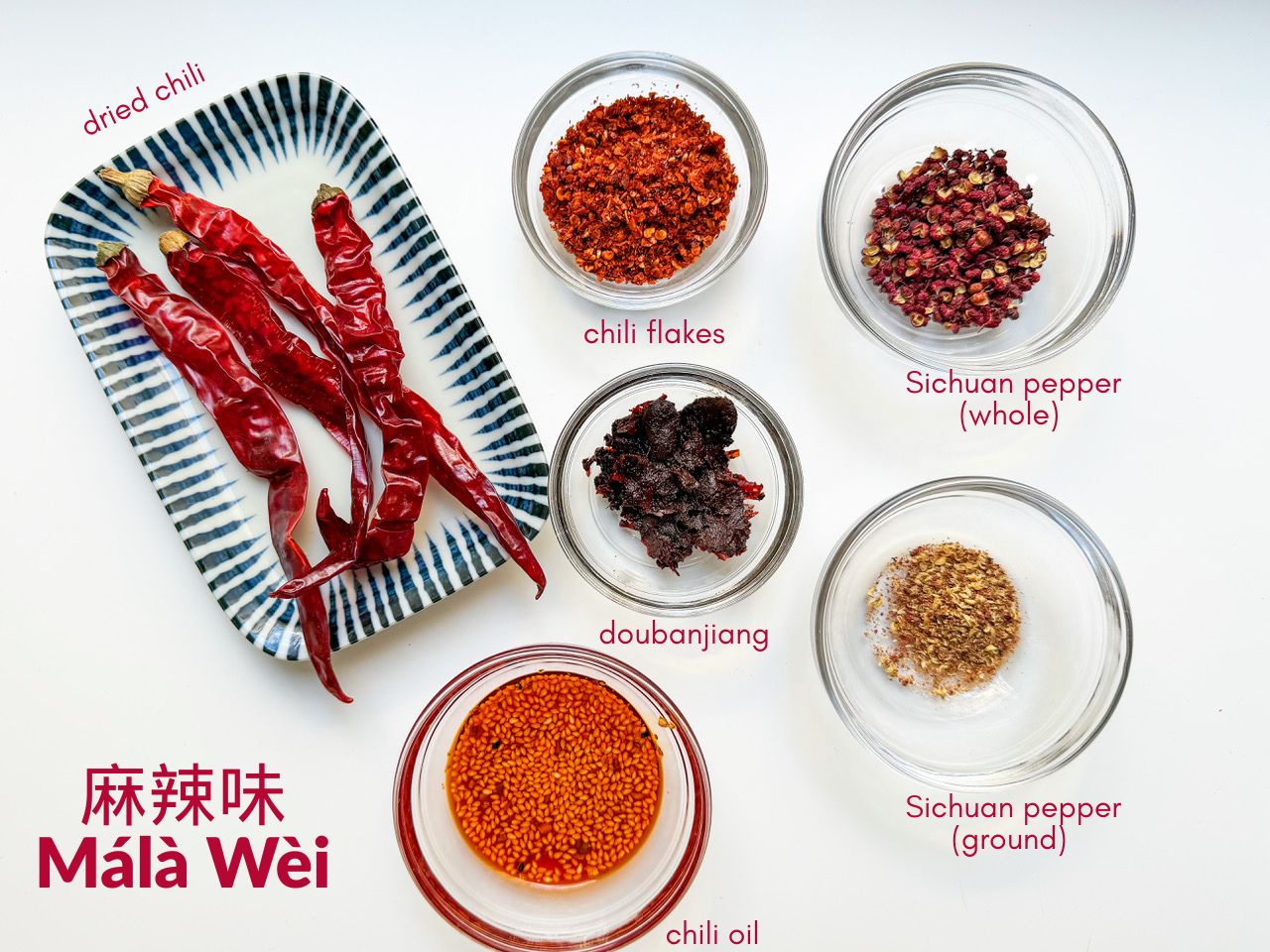
April 2026 Cook With Us!: Mala Wei Ingredients and Recipes
April 09, 2026
Cook With Us Through Sichuan's Complex Flavors!
Greetings, Friends of The Mala Market,
We're kicking off a new series on our recipe site and at the store that takes a deep dive into Sichuan's fuhe wei, or complex flavors, the 20-plus official flavor combinations that make Sichuan food so endlessly diverse and fascinating.
The first fuhe wei we're exploring is, of course, the most iconic, and our store namesake, mala wei—numbing-and-spicy flavor. Most of you have eaten a mala dish and many of you have cooked one. But even so, as we—myself, our blog editor, Georgia, and contributor Xueci, who was born and raised in Sichuan—all discovered as we delved deeper into mala wei: We all have more to learn.
So we hope you'll join us as we cook through Sichuan's complex flavors, one fuhe wei at a time—including the academy-taught official ones and a few flavors newer to the Sichuan food scene. If you have never cooked a mala dish, we encourage you to start with perhaps its most beloved representative, mapo tofu.
And for those old hands who have cooked mapo and many other mala dishes, we offer up a new challenge that exemplifies how mala wei is employed in cold dishes: the widely adored fuqi feipien, "husband and wife lung slices." (No, there's no lung involved!)
To make it even easier to learn about each fuhe wei, we'll be putting some of the core ingredients that define the featured flavor that month on sale, at a 20% discount! Keep reading to see which ones they are.
Enjoy! 🌶 Taylor & Fongchong 🌶
Mala Wei
On our recipe site, we are adding a new category page for each fuhe wei that will include the history and uses of the flavor as well as recipes representing it. If you love Sichuan food, you will find much to love on themálà wèi (麻辣味) page. Here is a taste:
The history of mala mirrors the development of Sichuan cuisine itself. At its core, mala (麻辣) is a marriage of native and once-foreign ingredients: ma, the tongue-tingling numbness of Sichuan peppercorn, with la, the heat of chili peppers....
This flavor profile continued to evolve through the 19th and 20th centuries with the invention and popularization of doubanjiang. The introduction of this fermented paste made from chili peppers and fava beans is considered the turning point in the transformation from ancient to modern Sichuan cuisine (as we know it today). Take mapo tofu, for example: Early versions of this dish relied on chili flakes and ground peppercorn, but by the early 20th century, cooks were combining doubanjiang with chili flakes, building complexity through multiple sources of heat....
According to The Encyclopedia of Sichuan Cuisine (川菜烹饪事典), mala wei can be built from different styles and forms of both chili peppers and Sichuan peppers:
Click on the above photo to see a short little 17-second video (on YouTube) showing how the mala flavor comes together for a cold dish—a salad, starter or side dish that's usually served room temperature. Contributor Xueci Cheng created the video to go with the story and recipe for this beloved cold dish. Here is an excerpt:
"One classic mala cold-dressed dish that I often enjoy when I’m home isfūqī fèipiàn (夫妻肺片), which usually translates, amusingly, to husband and wife lung slices. The story of this dish dates to the 1930s, when a husband-and-wife team, Guo Chaohua and Zhang Tianzheng, sold dressed beef offal from a Chengdu street stall. They worked with inexpensive cuts that others overlooked, cleaning and braising them meticulously before slicing and tossing them in a chili oil dressing.
"While the name of the dish contains the term “lung slices” (that’s the “feipian” part), there’s no lung in it. Instead, this dish consists of thinly sliced beef and beef offal, which can include tripe, heart, tongue and head skin....
"I’ve had many plates of fuqi feipian in my life. Some were exquisite, sliced paper-thin and served draped over celery with luscious red oil dripping into every bite. Others were more rustic, with thicker slices that were just tossed together in a stainless-steel bowl. It’s a dish that belongs as much to banquets as it does to the streets....
"This dish exemplifies the way that the mala flavor is often used in cold dishes. For meat dishes, the protein is usually braised in a spiced stock until tender, cooled and then dressed with mala sauce just before serving. This sauce is typically composed of chili oil, soy sauce, ground Sichuan pepper (or pepper oil), salt and sugar (as opposed to hot mala dishes, such as mapo tofu, which often use dried chilies or chili flakes). Frequently, a splash of stock is added to create a cohesive dressing. In many cities in Sichuan, you’ll find delicatessens selling this style of cold-dressed dishes (liángbàn cài, 凉拌菜) using ingredients like chicken, pork, rabbit and tofu products.
"This sauce is also a common dressing for crunchy vegetables like radish, celtuce or carrots.The vegetable is normally thinly sliced or julienned, and the moisture is drawn out with salt before it is tossed in the dressing."(We've got a recipe for that too!)
Note that for those who aren't fans of or can't access offal, fuqi feipian can be made with beef shank only.
Mala Supreme: Mapo Tofu
There was an earlier time on our blog—a dozen years ago!—when many of you cooked along with us on the Chengdu Challenge, what I called my attempt to teach myself Sichuan dishes by cooking through the classics. That was before the era of easy access to Chinese chefs on social media and YouTube, back when about the only sources of learning to cook Chinese were physical cookbooks.
I had been gifted a bilingual Chinese-English cookbook published by the Sichuan Higher Institute of Cuisine, which was the source for most of my challenges. And challenging they were, with their sparse instructions and shaky translations. But I also was lucky to take classes at the renowned school (Fuchsia Dunlop's alma mater!) several times, and learned to make mapo doufu there in 2007 from a charming young chef who soon became a friend.
This is the mapo tofu recipe the school taughtnot only the occasional visitor but also China's up-and-coming Sichuan chefs. I called it Chengdu Challenge #10, published in 2014. To this day, this numbing-spicy tofu treasure is the Sichuan dish I make the most often.
Da Hong Pao Sichuan Pepper (Szechuan Peppercorn, Hua Jiao)
$13.00
Normally $16 For má: Our best-selling Sichuan pepper is discounted 20% for Mala Wei Month!
Sichuan Mala Sauce for Stir-Fry and Dry Pot (Gluten-Free)
$11.00
Normally $14. Our very own Mala Sauce for Stir-Fry and Dry Pot exemplifies mala wei based on Pixian doubanjiang and Sichuan pepper (along with pickled chilies and fermented soybeans). Try it during this rare sale!
Fongchong and I were recently in San Diego, and of course we sought out Sichuan food while there. Spicy City wasn't on any "eat here" lists, but it was on highly Asian Convoy Street, and when we walked in the first thing I saw was a large refrigerated case displaying an exciting array of Sichuan cold dishes. Score! Liangcai are my favorite part of a Sichuan meal.
That's when we knew it would be good. And we weren't disappointed.
Even though it was only the two of us, I couldn't pick just three, so I got two plates of three salads each. Left plate: fuqi feipian (see recipe above!), pickled chicken feet, pickled long beans (tasted just like the ones we sell). Right plate: tea-smoked chicken, soy-noodle salad, garlic smashed cucumber.
I needed no more than these to be satisfied, but FC ordered a shuizhu-style spicy frog hot pot and loved it. For those keeping track of the fuhe wei, we had a mala wei cold dish and hot dish, along with pickled dishes and dishes from the smoked flavor profile (yan xiang wei) and garlic-paste flavor (suan ni wei).
This is a common sight in Sichuan, but I wish more Sichuan restaurants in the U.S. offered this cold-dish spread, meaning more than a few different kinds that you can see before ordering.Do you know of any? Let me know, and I'll share a list in a future newsletter.