November 2026: NEW Pickled Er Jing Tiao Chilies + Ginger Flavor Recipes
November 08, 2026
Pickled Er Jing Tiao
Greetings, Friends of The Mala Market,
This week's newsletter is focusing on not one, but two less-familiar but super enticing Sichuan flavor profiles.
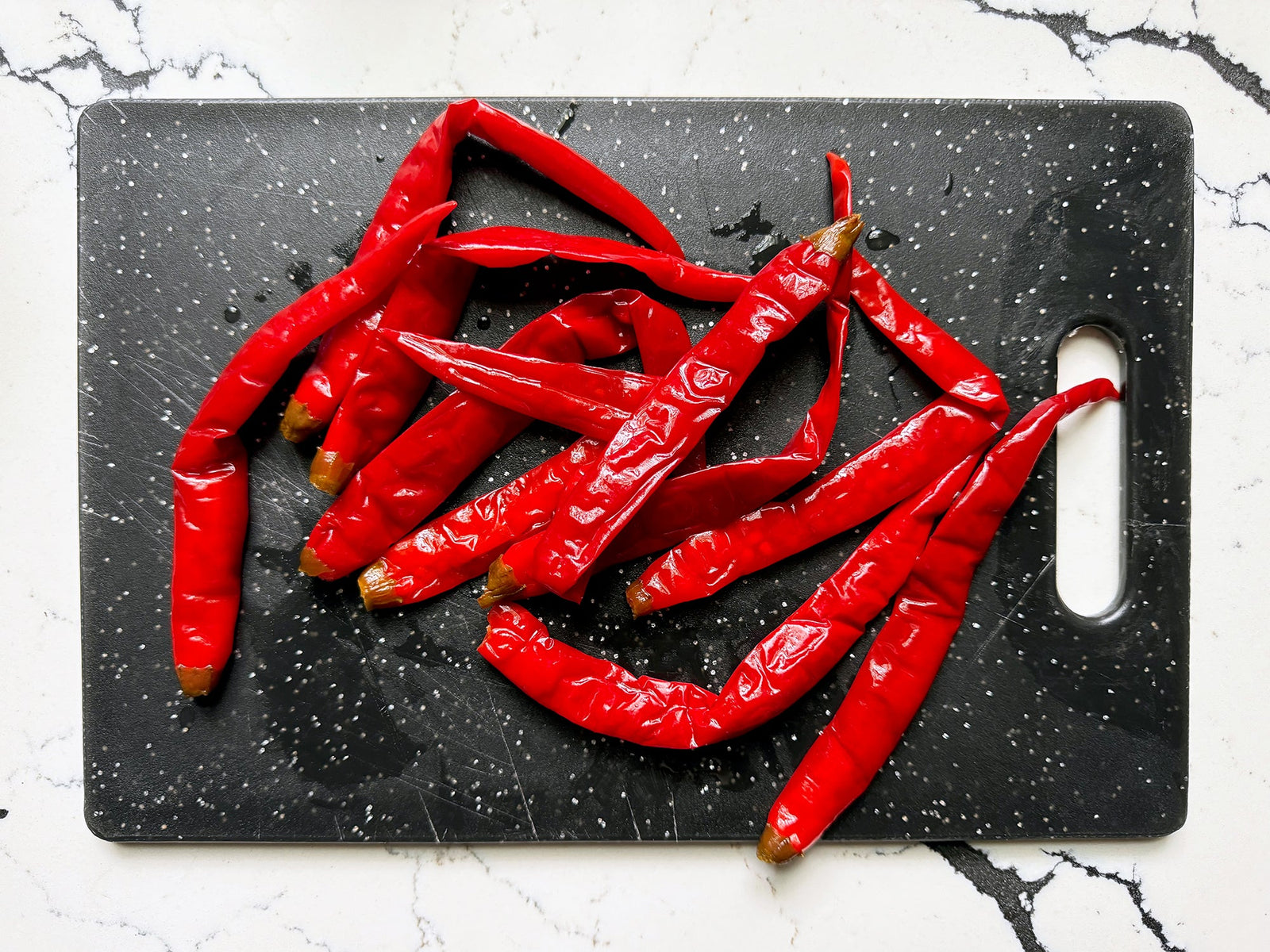
First up is pao la jiao, or pickled chili, flavor. While not an official Sichuan flavor, it is frequently used to flavor all kinds of dishes. After years of working on it and eventually locating and visiting a heritage Sichuan pickle factory in 2024, we have finally imported some exquisite pickled er jing tiao chilies! They're so enticing they make any other you've seen look sad by comparison. Keep reading for all the juicy details.
We've also published another in our series on Sichuan's official complex flavor profiles. This week it is jiangzhi wei, or ginger juice flavor. We've got a recipe for green beans in ginger sauce that would make a grand addition to your Thanksgiving table.
To make it even easier to learn about each fuhe wei, we're putting some of the core ingredients that define the current featured flavor on sale, at a 15% discount on individual prices! This month it is our China Time-Honored Brand Collection, which includes all the pantry ingredients to make ginger flavor. Just add ginger!
This short-lived sale is also a great opportunity to purchase this impressive collection as a holiday gift.
Pickled Er Jing Tiao Chilies (Sichuan Pickled Chilies, Pao La Jiao), Set of 2
$15.00
Set of two packages
If you're going to pick a pack of pickled peppers, this is the pack to pick.
One of the most elusive Sichuan ingredients outside the province, the pickled version of Sichuan's favorite chili is used in many popular dishes. Ripe red er jing tiao chilies are naturally fermented in a salt brine in large earthenware crocks until they are mildly soured.
The heritage Laotanzi brand has been making Sichuan pickles since 1902 and boasts that its "mother brine" is more than a century old—meaning that the brine in each 5-foot-tall earthenware pickling crock has been jumpstarted by lactic acid bacteria that has propagated through the generations. This natural lacto-fermentation in a salt brine is the same process as the home pickle jar, just in a much larger crock. No vinegar involved!
Er jing tiao is a mild to medium-hot chili. It is the chili that is fermented with fava beans to make Pixian doubanjiang, which is used to flavor dozens of classic Sichuan dishes. But sometimes the fermented chilies stand on their own to flavor a dish, for a lighter touch, or as a substitute for doubanjiang that is bean- and gluten-free.
These pickled peppers, or pao la jiao, are used to lend a mildly spicy tang to fish stews/hotpots, pickled pepper beef noodles and some yuxiang, or "fish fragrant," dishes. But they are welcome anywhere you'd like a little pickled pepper punch.
These are the chilies for the job whenever a recipe suggests using sambal oelek or, unwisely, sriracha in a traditional Sichuan dish. Just mince them up and you've got a pickled chili sauce that complements Sichuan food perfectly.
Ginger juice flavor, or jiāngzhī wèi (姜汁味), is one of Sichuan’s simplest yet most refreshing flavor combinations. The flavor is typically built around ginger juice, black vinegar, sesame oil and salt. It can be bright and pungent in cold dishes or deeper and more aromatic in warm dishes. Classic uses range from braised chicken with ginger juice (jiāngzhī rèwōjī, 姜汁热窝鸡) to cold ginger long beans (jiāngzhī jiāngdòu, 姜汁豇豆).
Ginger is native to China and has been an essential ingredient in the Chinese kitchen for millennia. The fourth-century text Chronicles of Huayang (《华阳国志》) describes the people of the region as “hao xinxiang” (好辛香), or fond of pungent aromas. Long before the arrival of the chili pepper, ginger was one of the ingredients that gave Sichuan cooking its characteristic pungency and heat.
The food historian Lan Yong, from Southwest University in China, argues that the generous use of ginger is a characteristic that has been passed down from ancient Sichuan cuisine, while modern Sichuan cuisine was shaped by the later introduction of chilies and the development of doubanjiang. Today, this tradition is perhaps most evident in southern Sichuan, where ginger is used especially generously.
Ginger is an indispensable aromatic in many Sichuan dishes and an important component of several fuhe wei, including fish-fragrant flavor (yúxiāng wèi, 鱼香味) and litchi flavor (lìzhī wèi, 荔枝味). In jiangzhi wei ginger takes center stage, and its sharp, warm fragrance becomes the dish’s defining flavor; the other ingredients also used to build this profile (the vinegar, soy sauce, etc) simply augment and round out the root’s natural aroma and heat.
Jiangzhi wei is described as having a “rich gingery flavor—savory, umami and slightly spicy” (姜味醇厚,咸鲜微辣). It is used in both cold and warm dishes.
Core ingredients: ginger, black vinegar, salt, sesame oil, soy sauce
Frequent ingredients: stock, msg, chili oil, doubanjiang
While the base flavors are salty and savory, the focus is on fresh ginger balanced with black vinegar.
***
Here's where I'll admit that we have only one recipe thus far in this fuhe wei. But we hope to change that with a ginger-juice braised dish in the not-too-distant future.
Green Beans in Ginger Sauce
Click on the photo/video above to see jiangzhi wei in action!
May we suggest that you ditch the green bean casserole this Thanksgiving and substitute a fresh and boldly flavored green bean dish? That's what we're going to do, because this sophisticated dish, with its refreshing ginger and black vinegar, would make a welcome, healthy counterpoint to the heavier, richer dishes on the table.
"Green beans in ginger juice is one of those Sichuan dishes I’ve come back to again and again since I first made it a few years ago. Tender, crisp green beans are coated in a pungent and refreshing sauce, making a perfect side dish for rich foods. It requires only a handful of ingredients and takes about 20 minutes to prepare. The dish is a variation of jiāngzhī jiāngdòu, 姜汁豇豆, which is traditionally made with snake beans or Chinese long beans (or yardlong beans). But thin green beans, like the kind found in U.S. markets, or French haricots verts make an excellent substitute....
"As the name suggests, this flavor profile puts ginger front and center, highlighting its pungent aroma and sharp, warming heat. Jiangzhi wei is used in both cold and warm dishes, but in cold dishes, the ginger flavor is more concentrated because the ginger is minced or grated and combined with black vinegar, salt, sesame oil and soy sauce (which balance and round out the ginger’s bright spiciness) to make a dressing for vegetables or meat, while in hot dishes the main ingredient is normally simmered or stir-fried before being braised with minced ginger or ginger juice, stock, salt, vinegar and soy sauce....
The term "ginger juice" can be misleading, however—sometimes this liquid is the actual “juice” from the ginger root, and sometimes it refers to a sauce that includes a lot of ginger....In Sichuan recipes, there are a few ways to make these mixtures, including smashing, pounding or mincing the root. I’ve also seen ginger blended with water in a food processor."
Xueci tested several methods to find the best one for extracting the flavor from the ginger root. Find the results in the recipe.
China Time-Honored Brand Collection
$108.00
Normally $120. Sale price is a 15% discount on individual prices; 10% discount on normal bundle price.
We rarely put this collection or any of the individual products on sale, so this is your best chance to get the best of the best Chinese sauces with 15% savings.
A bundle of our top-of-the-line sauces, the China Time-Honored Brand Collection includes Sichuan's finest handcrafted soy sauce, 20-year black vinegar, 3-year aged doubanjiang (chili bean paste) and 3-year douchi (fermented soybeans), as well as the country's most honored roasted sesame oil.
A China Time-Honored Brand has been in business for at least 50 years, but most of these have been operating in various forms for centuries and have survived the challenges of emperors, wars, invasions, revolution, collectivization and renewed competition. Somehow, the knowledge, skills and recipes have been retained, and we can still experience how these quintessential Sichuan ingredients tasted at their origin.
Of course, factories have also been automated and expanded over the years, and all of these companies now make mass-market versions of their products as well, but what we've gathered here are the handmade versions they still make in very small batches in the traditional way—the highest expressions of their craft.
Outside China the Sichuan sauces are exclusive to The Mala Market, and even within China they are difficult to procure.
I did not make these noodles, I merely ate them at a beloved noodle house in Chengdu that serves an array of superb noodles. While I usually order the dan dan mian or the wheat noodles topped with minced pork and pickled green beans, last time I went for something new: jiao xiang niurou mian, or minced beef with peppers, which turned out to feature pickled er jing tiao in abundance.
Perhaps someday I'l find time to develop a recipe for this, but in the meantime I realized it is very similar to Xueci's Yibin beef noodles with fresh chili. Just substitute pickled er jing tiao for the fresh chilies and cook 2-3 of them, roughly chopped, in with the beef topping; then replace the cilantro topping with diced celery and celery leaves and you'll have something close to the legendary noodles at Chun Yang Guan. So delicious!
The Home of Pao Cai
The process of lacto-fermenting vegetables used at the Laotanzi factory has National Intangible Cultural Heritage status, designating a traditional handmade production process passed down through the generations.
When we visited the Laotanzi factory (see Fongchong and our Chengdu team above), we not only saw the 1,200 5-foot-tall earthenware crocks, each of which can hold 1,000 kilograms (2,200 pounds) of pickles-in-process, we heard them. Just like the Sichuan home pickle jar, these have a moat around the lid that is filled with water and the crocks gurgle as the gases from the fermentation process escape through the lid.
Laotanzi is located in Meishan, a city in southern Sichuan Province that calls itself the paocai (pickle) capital of China, due both to the long history of pickle production there and the amounts local companies currently produce. A giant museum devoted to the history of paocai is near the factory.